Protocol Note
Sofwave for the jawline: what the 1.5 mm mid-dermis can and cannot do
Seven synchronous transducers, a single mid-dermal depth, and a candidate-selection question that is far more important than the platform itself. An honest editorial read on Sofwave jawline treatment in Gangnam for patients planning a Korean consultation.
The jawline is the region where Sofwave is most actively marketed to international patients and the region where the candidate-match question is most frequently mishandled. The honest editorial read, written from a Singapore-comparative perspective and informed by Korean-resident editor input on Gangnam-area clinical practice, is that Sofwave addresses a specific and well-defined slice of the jawline-laxity spectrum — the dermal-quality dimension of contour blur, the early-stage jawline softening that has not yet progressed to structural jowl descent, and the post-surgical maintenance segment for patients who want to preserve dermal quality without committing to a deeper-targeting ultrasound protocol. Sofwave is not a substitute for surgical jawline contouring in patients whose laxity has progressed into the SMAS layer with visible jowl descent, and any clinic that suggests otherwise is overselling the platform. This guide walks through the seven-transducer SUPERB array architecture, the 1.5 millimetre mid-dermal targeting depth, the comparative read against surgical jawline approaches and against deeper-targeting ultrasound, the Korean-market protocol patterns that the dominant Gangnam-area senior physicians deploy, and the candidacy logic that determines whether Sofwave is the right platform for the patient's actual anatomy. The candidacy assessment is more important than the platform — readers who arrive expecting a clean endorsement will find a more nuanced read.
The seven-transducer SUPERB array and why the architecture matters for jawline work
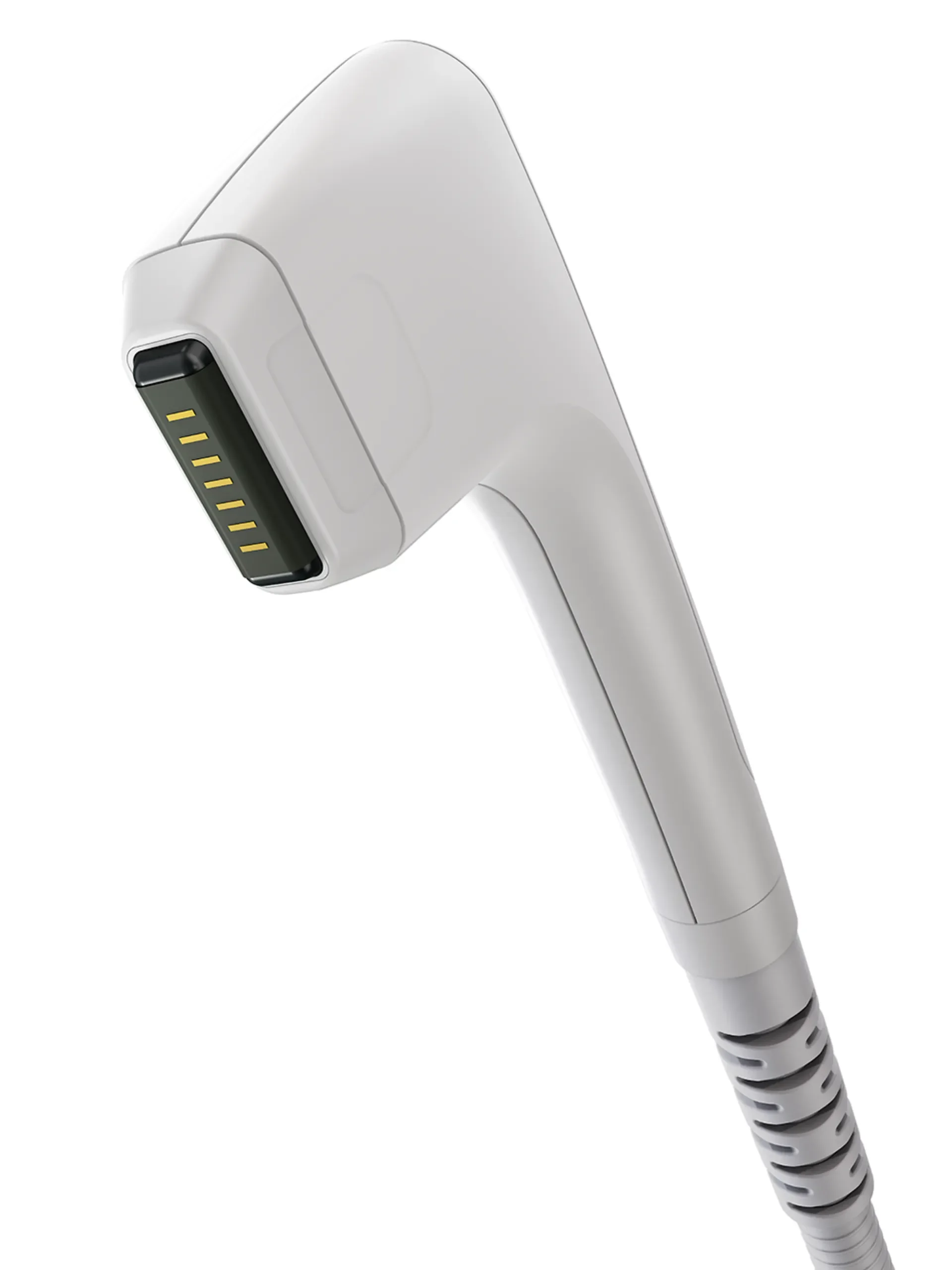
Sofwave's Synchronous Ultrasound Parallel Beam (SUPERB) array fires seven transducers simultaneously, producing seven coordinated coagulation zones per pulse. Each pulse covers a defined stripe, and the operator advances the handpiece in a methodical pattern across the jawline, chin, perioral area, and as candidate-appropriate the upper neck. The architectural consequence for jawline work is that the seven parallel beams produce a uniform mid-dermal coagulation pattern across the contour line rather than the discrete focal-coagulation points produced by sequential single-beam ultrasound platforms. Uniform dermal coagulation is the right architecture for the patient whose primary concern is contour blur driven by dermal-quality decline — the loss of collagen-and-elastin density that produces a soft, less-defined jawline edge in patients in their thirties and early forties. The synchronous-beam architecture is documented in detail in Sofwave Medical's clinical-evidence library alongside the 510(k) clearance pathway. The architecture is not engineered for SMAS-level structural work — patients whose jawline laxity has progressed into the deeper supporting layers require either a deeper-targeting ultrasound platform or a surgical approach.
1.5 millimetre depth: precision in the mid-dermis, not the SMAS
Sofwave delivers its energy at approximately 1.5 millimetres into the mid-dermis. This depth is the layer where dermal collagen and elastin reside, where remodelling produces visible skin-quality improvement, and where the patient experiences mild warmth rather than the deep-tissue pulse felt at SMAS-targeting depths. The depth choice is the parameter that defines the candidate-selection logic for jawline work. A patient whose jawline contour blur is driven by dermal-quality decline will respond well — the dermis tightens, collagen density increases over three to six months, and the contour line sharpens incrementally as the dermal architecture matures. A patient whose jawline laxity is driven by SMAS-level descent with visible jowl shadow will not see comparable improvement, because Sofwave does not deliver energy to the layer where the structural problem sits. The depth choice is also why Sofwave is more tolerable than deeper-targeting ultrasound platforms; the energy is deposited in the dermis rather than at the SMAS-targeting depth where sensory innervation is denser. This depth-versus-anatomy match is the discussion that should dominate any pre-treatment consultation. The Korean Society for Dermatologic Surgery publishes Korean-resident commentary on energy-based platform selection that is worth reading alongside the manufacturer documentation.
What the jawline patient actually feels during the procedure
The patient-experience read for Sofwave on the jawline is meaningfully better than for deeper-targeting ultrasound and broadly comparable with monopolar radiofrequency on the comfort scale. After topical anaesthetic for twenty to thirty minutes, the patient lies supine while the operator advances the handpiece in a stripe pattern across the lower face. Each pulse delivers a brief warm-pulse sensation lasting one to two seconds; occasional pulses near the bony landmarks of the mandible produce a fleeting sharper sensation that is well-tolerated by most patients. Oral analgesia is rarely required, intravenous sedation is essentially never required, and the patient can drive, work, or fly the same day. A jawline-focused protocol runs twenty-five to forty-five minutes from skin preparation to handpiece-down. The patient-experience advantage is the reason Sofwave has captured the segment of patients who have previously found deeper-targeting ultrasound uncomfortable enough that they are reluctant to repeat the procedure.
Comparison with surgical jawline approaches: what each modality addresses
The honest comparison between Sofwave and surgical jawline approaches is a comparison between different anatomical interventions rather than a comparison between competing solutions for the same problem. Surgical jawline contouring — mandibular angle reduction, genioplasty, lower-face lift, deep-plane lift, buccal fat pad reduction — addresses the bony architecture, the soft-tissue support layers, the SMAS, the platysma, and the volumetric distribution of the lower face. The intervention is structural, the change is permanent, the downtime is meaningful, and the candidate is a patient whose anatomical problem sits at one of those structural layers. Sofwave addresses the dermal layer alone. It does not move bone, does not reposition SMAS, does not address platysma banding, and does not contour fat compartments. The two modalities are not competitors; they sit in different lanes. The trap for international patients is the marketing language that positions non-surgical ultrasound as a 'no-knife alternative' to surgical lifting — this framing is misleading when the patient's actual anatomy requires structural work. A senior Gangnam-area physician will tell the patient honestly when surgery is the right answer and when energy-based dermal remodelling is the right answer.
Where Sofwave sits within Korean Gangnam-area protocol patterns for the jawline
Gangnam-area senior physicians deploy Sofwave for the jawline within a small number of well-defined protocol patterns. The first and most common is the early-laxity dermal-quality protocol: a patient in their thirties or early forties with contour blur driven by dermal decline receives a single Sofwave session focused on the lower face and upper neck, with results assessed at the three-month and six-month follow-up. The second pattern is the multi-modality combination: Sofwave addresses the dermal dimension while a separate modality — radiofrequency microneedling, biostimulator injectables, or in advanced cases a deeper-targeting ultrasound platform — addresses an adjacent dimension. The third pattern is the post-surgical maintenance protocol: a patient who has undergone surgical jawline work one to three years prior receives Sofwave as a dermal-quality maintenance treatment without committing to a deeper-targeting platform that would produce additional thermal stress on surgically-modified tissue. Across these patterns, the senior physician's candidacy assessment determines which applies. The Korea Health Industry Development Institute maintains the medical-tourism facilitator registry and publishes Korean-market practice-pattern data.
Results trajectory: gradual three-to-six month build with no immediate change
Sofwave's jawline results signature is a gradual three-to-six month build with essentially no immediate post-treatment change. The patient leaves the clinic looking identical to baseline; mild erythema fades within two to four hours; there is no same-day cosmetic improvement to photograph. Subtle improvement appears around four to eight weeks; peak result is typically apparent at the three-to-six month follow-up window as collagen-and-elastin reorganisation matures. The candidate-expectation consequence is significant: a patient who values immediate visible feedback may be disappointed by Sofwave's purely-gradual signature. The honest pre-consultation read is that Sofwave is the right platform for patients comfortable with a three-to-six month build and the wrong platform for patients who need an immediate change. A second Sofwave session at the six-month or twelve-month interval is a common Korean-market pattern for patients whose response to the first session is modest; the senior physician will assess at follow-up and recommend cadence.
Pricing in Gangnam-area clinics and what the cost variance reflects
Korean-market pricing for Sofwave jawline protocols in Gangnam-area clinics typically ranges from KRW 800,000 to KRW 2,800,000, with single-region focused protocols at the lower end and combined jawline-and-upper-neck protocols toward the upper end. Full face-and-neck protocols extend higher, into the KRW 1,500,000 to KRW 3,500,000 range. The cost variance across clinics largely reflects physician seniority, clinic positioning, and beam-pulse density rather than platform authenticity — all authorised Sofwave providers in Korea operate the same Sofwave Medical hardware under the same Ministry of Food and Drug Safety clearance framework. International patients should ask explicitly about pulse count at consultation and be wary of pricing that sits substantially below the Gangnam-area band. Detailed pricing context is documented in the Korean pricing guide.
Frequently asked questions
Will Sofwave give me a sharper jawline?
Sofwave will sharpen the jawline contour when the contour blur is driven by dermal-quality decline rather than by SMAS-level descent or by bony architecture. The gain is incremental and matures over three to six months; the gain is not dramatic. A patient whose jawline concern is structural will need a deeper-targeting platform or a surgical approach; Sofwave is not a substitute for either.
Can Sofwave lift jowls?
Not meaningfully. Jowl shadow is driven by SMAS-level descent and by volumetric redistribution at the deeper layers; Sofwave does not deliver energy to either of those layers. A patient with visible jowl shadow should discuss either a deeper-targeting ultrasound platform that reaches the SMAS or a surgical lift consultation. Sofwave can address the dermal-quality dimension as an adjunct but cannot reverse jowl descent.
How is Sofwave different from a surgical lower-face lift for the jawline?
Surgical lower-face lifting addresses the structural support layers — SMAS, platysma, soft tissue — and produces a structural repositioning that energy-based platforms cannot replicate. Sofwave addresses the dermal layer alone. The two are not direct alternatives; they are interventions at different anatomical layers for different patient candidacy profiles. A senior physician's honest assessment of which intervention matches the patient's actual anatomy is more useful than any pre-consultation preference.
When will I see jawline results from Sofwave?
Subtle improvement appears around four to eight weeks; peak result is typically apparent at the three-to-six month follow-up window as dermal collagen-and-elastin remodelling matures. There is no immediate post-treatment change. A patient who needs visible improvement for an event within four weeks of treatment is not a good Sofwave candidate; the build is gradual.
How many Sofwave sessions does the jawline need?
Many patients see meaningful improvement from a single well-protocolled session; a subset of patients with more substantial dermal-quality decline benefit from a second session at the six-month or twelve-month interval. The senior physician's six-month follow-up assessment determines the cadence. Do not pre-commit to a multi-session package before the first session has been delivered and assessed.
Is Sofwave painful on the jawline area?
The patient-experience read is mild-to-moderate warmth at most pulses with occasional fleeting sharper sensations near the bony landmarks of the mandible. Topical anaesthetic for twenty to thirty minutes is the standard pre-treatment; oral analgesia is rarely needed; intravenous sedation is essentially never required. The platform is meaningfully more tolerable than deeper-targeting ultrasound on the same anatomical region.
Can I combine Sofwave with surgical jawline contouring?
Yes, in some cases — Sofwave is commonly deployed as a dermal-quality maintenance treatment one to three years after surgical jawline work. The senior physician will assess the surgical-recovery status and determine whether energy-based dermal remodelling is appropriate; the combination should not be self-protocolled. Patients should not undergo Sofwave on freshly surgically-modified tissue; allow appropriate healing time.
Is Sofwave Ministry-of-Food-and-Drug-Safety cleared for Korean clinical use?
Yes — Sofwave holds Korean MFDS clearance and is operated under that regulatory framework by authorised providers in Gangnam-area clinics. The platform also holds the original FDA 510(k) clearance from 2019. Patients can request to see the clinic's MFDS-cleared equipment documentation at consultation; senior clinics make this available without hesitation.