Protocol Note
Sofwave SUPERB: how the platform actually works
Seven simultaneous ultrasound beams, ~1.5 mm depth, FDA cleared for facial lifting, fine-line improvement, and submentum-and-neck treatment. The mechanism is meaningfully different from Ultherapy — and that difference matters.
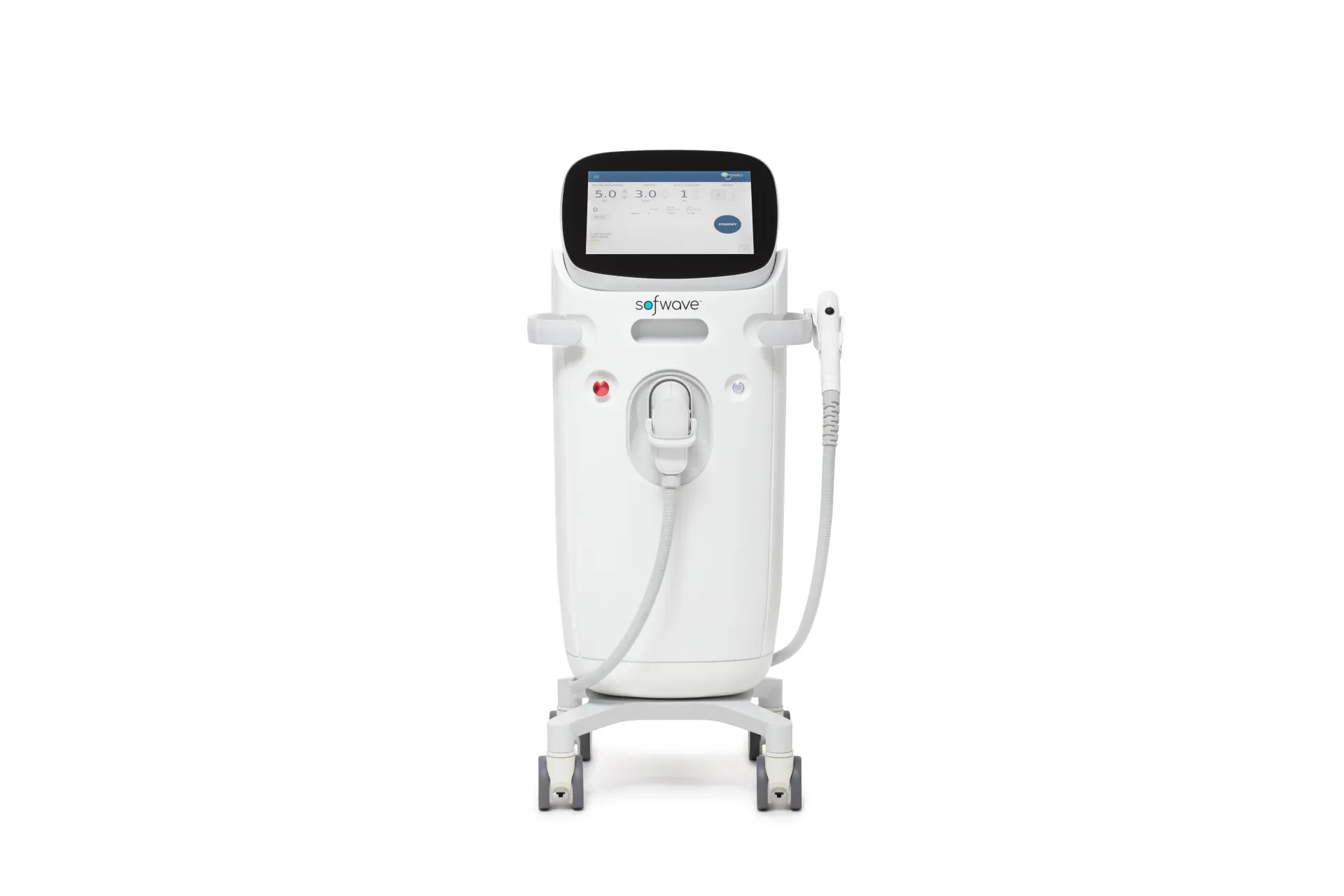
Sofwave was developed by Sofwave Medical in Israel and launched commercially after receiving its initial United States FDA 510(k) clearance in 2019 for lifting the lax submentum, neck, and eyebrow. Subsequent clearances expanded the indications to include the improvement of facial lines and wrinkles and the short-term improvement of cellulite. The platform's distinguishing engineering signature is what the manufacturer calls Synchronous Ultrasound Parallel Beam — abbreviated SUPERB — in which seven ultrasound transducers fire simultaneously to deliver coordinated thermal-coagulation zones at approximately 1.5 millimetres into the mid-dermis. This is meaningfully shallower than the 4.5 millimetre SMAS-level targeting of micro-focused ultrasound platforms like Ultherapy, and meaningfully deeper than the upper-papillary-dermis zones that fractional non-ablative lasers reach. The depth choice matters clinically: at 1.5 millimetres the platform is engineering itself to remodel the mid-dermal collagen-and-elastin matrix without engaging the SMAS layer, which produces a particular signature of refined skin firmness and modest tightening rather than structural lift. For ASEAN-region readers — particularly in Singapore, Hong Kong, Taipei, and Tokyo — Sofwave has become an editorial reference point in the early-laxity category where SMAS-depth intervention is premature but dermal regenerative work alone is not enough. This overview lays out the mechanism, the cleared indications, the depth rationale, and the honest read on what the platform does and does not deliver.
The seven-transducer SUPERB architecture and why simultaneity matters
Older focused-ultrasound platforms — including the original Ultherapy hardware — work in a sequential-shot architecture: a single focal point delivers energy to one coagulation zone, the operator advances the handpiece, the next zone is treated, and so on across the treatment area. The clinical result is meaningful but the session is long, the operator-dependence is high, and the patient-discomfort pulses are spaced out across the procedure. Sofwave's seven-transducer SUPERB array fires the beams synchronously: each pulse delivers seven coordinated coagulation zones simultaneously, the handpiece advances in a stripe pattern across the treatment area, and the cumulative session time for a face-and-neck protocol typically lands at 30 to 45 minutes versus the 60 to 90 minutes a Ultherapy PRIME face-and-neck protocol commonly requires. The simultaneity is not just a speed gain — it produces a more uniform thermal-pattern distribution across the treatment area, which clinical investigators have argued contributes to the platform's particular lifting-and-tightening signature. The handpiece itself integrates real-time skin-cooling at the contact surface, which is part of why patient-reported tolerability sits closer to Thermage FLX than to Ultherapy on the comfort scale. The Sofwave Medical clinical-evidence page catalogues the published studies that establish the dose-response and safety profile of the SUPERB architecture across Fitzpatrick I-VI skin types.
The 1.5 millimetre dermal depth — and why the depth choice is the platform's identity
The depth at which a non-surgical lifting device delivers its energy is the single most important engineering decision in this category, and Sofwave's choice of approximately 1.5 millimetres into the mid-dermis is what gives the platform its clinical lane. At this depth, the energy engages the dermal collagen-and-elastin matrix — the structural framework that gives skin its firmness — without reaching the deeper SMAS muscular-aponeurotic layer that Ultherapy targets at 4.5 millimetres for its structural-lift signature. The clinical consequence is that Sofwave produces what physicians describe as a refined, firmed, mid-dermal remodelling response: improved skin texture and quality, reduction in fine-line laxity, and modest tightening at the upper-cheek and lower-face contours. It does not produce SMAS-level structural elevation. For a patient in their early thirties with first-stage laxity and skin-quality concerns, this is exactly the right depth — the SMAS-level intervention would be premature, and the dermal regenerative work alone would underdeliver. For a patient in their late fifties with significant SMAS-level laxity and jowl descent, the 1.5 millimetre depth is the wrong tool — the platform cannot reach the structural anatomy that needs intervention, and the clinical consequence is patient disappointment. Korean clinical practice has developed a nuanced approach to this candidate-selection question, and the American Society for Dermatologic Surgery clinical-pearls library carries useful generalist guidance on depth-selection for non-surgical lifting that aligns with how Korean-resident editors at the parent network describe in-clinic protocol logic.
FDA-cleared indications and what they actually authorise
Sofwave has accumulated three primary FDA 510(k) clearances since 2019. The first, granted under K183303, authorises the device for lifting lax submentum, neck, and eyebrow tissue. The second, granted under K203567, expanded the indications to include the improvement of facial lines and wrinkles. A third clearance, granted under K212867, added the short-term improvement of the appearance of cellulite. The cleared indications in the United States are the regulatory anchor that informs Korean clinical practice, although Korea's Ministry of Food and Drug Safety operates its own platform-registration process and Korean clinics use the platform within the scope of their domestic regulatory authorisation. The practical implication for an international patient evaluating Sofwave in Korea is that the platform's regulatory pedigree is well-established globally — FDA clearance in the United States, MFDS registration in Korea, CE-mark in Europe, TGA registration in Australia, and equivalent authorisations in most major markets. Patients should still verify that the specific clinic operates an authentic Sofwave device by cross-checking against the Sofwave Medical authorised-provider directory, which is the manufacturer's own list. The verification step is a small action that prevents the documented Korean-market issue of clinics advertising 'Sofwave-equivalent' or 'parallel-beam ultrasound' systems that are not in fact Sofwave hardware.
What a Sofwave session looks like — protocol, timing, and what to expect
The standard Sofwave face-and-neck protocol in Korean clinical practice follows a recognisable pattern. The patient arrives, completes a brief consultation with the senior physician covering candidacy, expectations, and safety screening, and is photographed for baseline documentation. Topical anaesthetic cream is applied for 20 to 30 minutes — typical Korean-clinic anaesthetic compounds include lidocaine and prilocaine in concentrations comparable to EMLA. The treatment area is mapped using the manufacturer's recommended beam-pattern grid, which guides the operator across the face and neck in overlapping stripes to deliver uniform coverage. The handpiece is applied in firm contact with a coupling gel, and each stripe of treatment delivers a sequence of synchronous seven-beam pulses with brief skin-cooling between pulses. Patients describe brief warm sensation at each pulse, occasionally a fleeting sharp sensation at higher-energy settings near the bony landmarks of the face. The total handpiece-on-skin time for a face-and-neck protocol is typically 25 to 35 minutes; total clinic-room time including consultation, photography, anaesthetic, and post-treatment debrief lands at 90 to 120 minutes. Mild post-treatment erythema is common and typically resolves within two to four hours; substantial swelling is uncommon. There are no incisions, no general anaesthesia, no bandages, and no functional downtime. Patients commonly attend evening appointments the same day. The lifting and tightening response develops gradually over three to six months as collagen remodelling matures, with peak result generally apparent at the three-to-six month follow-up window.
How the result reads, honestly — neither dramatic nor cosmetically trivial
The honest editorial read on Sofwave's clinical signature is that the result is meaningful but undramatic — and that the platform reliably disappoints patients hoping for surgical-level transformation while reliably satisfying patients matched to its actual clinical lane. The published patient-satisfaction data in the manufacturer's clinical-evidence library and in independent peer-reviewed studies cluster strongly with the candidacy match: patients in their thirties and forties with early-stage laxity report satisfaction rates in the 80-to-90 percent range at three-month follow-up, while patients in their late fifties with significant SMAS-level laxity who chose Sofwave over Ultherapy report substantially lower satisfaction. The result, at its best, is a refined-and-firmed dermal-quality presentation. Skin firmness improves modestly. Fine-line laxity reduces. The lower-face contour appears slightly tighter without the operative-look elevation that surgical work or aggressive thread-lifting produces. Patients evaluating their own response three months out should compare baseline photography against follow-up photography under matched lighting; the day-to-day mirror does not register the change reliably because the skin-quality improvements develop too gradually for daily perception. The result is, by design, a refinement rather than a transformation — and reading it as such is the difference between a satisfied Sofwave patient and a disappointed one.
Where Sofwave sits in the broader Korean non-surgical lifting ecosystem
Korean clinical practice has a well-developed taxonomy for non-surgical lifting that integrates Sofwave alongside Ultherapy, Thermage, radiofrequency microneedling, and regenerative bio-actives such as exosome and growth-factor protocols. The dominant pattern in Gangnam-area clinics is to use Sofwave as a dermal-quality treatment for the early-laxity-and-skin-quality patient profile, to use Ultherapy or Ultherapy PRIME for SMAS-level structural intervention in patients with more advanced laxity, and to combine modalities across two visits in a multi-day Seoul trip when the patient's clinical picture warrants both dermal and SMAS-level work. Thermage FLX occupies a parallel lane focused on volumetric monopolar radiofrequency heating that addresses both dermis and subcutaneous fat — different mechanism, related lane. Regenerative bio-actives are typically layered into the protocol on a separate visit 48 to 72 hours after Sofwave to leverage the post-treatment dermal-receptivity window. The combination logic is what international patients planning a Korean trip benefit most from understanding before consultation. For the comparative read on focused-ultrasound alternatives, see the Sofwave-versus-Ultherapy comparison which lays out the depth, comfort, downtime, and cost differences in detail. For pricing context, see the Korean pricing guide.
Frequently asked questions
What does SUPERB stand for, and how is it different from regular ultrasound lifting?
SUPERB stands for Synchronous Ultrasound Parallel Beam — Sofwave Medical's term for the seven-transducer simultaneous-fire architecture. The difference from sequential focused-ultrasound platforms (like the original Ultherapy hardware) is that Sofwave's beams fire simultaneously at approximately 1.5 millimetre dermal depth, which produces a faster session, a more uniform thermal pattern, and a meaningfully different clinical signature focused on dermal-quality rather than SMAS-level lifting.
What FDA clearances does Sofwave hold?
Sofwave has primary FDA 510(k) clearances for lifting the lax submentum, neck, and eyebrow (K183303), improvement of facial lines and wrinkles (K203567), and short-term improvement of the appearance of cellulite (K212867). Korean clinical use operates under Korean Ministry of Food and Drug Safety platform registration, which patients can verify with their treating clinic.
How long does a Sofwave face-and-neck session take?
The handpiece-on-skin time is typically 25 to 35 minutes; total clinic-room time including consultation, photography, topical anaesthetic, and post-treatment debrief lands at 90 to 120 minutes. The session is meaningfully shorter than a typical Ultherapy PRIME face-and-neck protocol, which commonly runs 60 to 90 minutes of handpiece time.
How deep does Sofwave penetrate the skin?
Approximately 1.5 millimetres into the mid-dermis. This is meaningfully shallower than Ultherapy's 4.5 millimetre SMAS-level targeting and meaningfully deeper than the upper-papillary-dermis zones reached by fractional non-ablative lasers. The depth choice is what gives Sofwave its dermal-quality clinical signature.
Does Sofwave work for all skin types?
Sofwave's published clinical evidence covers Fitzpatrick I through VI skin types, which spans the full range of ASEAN-region complexions. The platform's bulk-heating mechanism — as distinct from chromophore-targeted laser energy — means melanin-pigmentation interaction is minimal and the post-inflammatory hyperpigmentation risk that complicates some laser platforms in Fitzpatrick IV-VI skin is not the same concern with Sofwave.
Is Sofwave a substitute for a surgical facelift?
No. Sofwave produces dermal-quality remodelling and modest tightening, not structural elevation. Patients with significant SMAS-level laxity, jowl descent, or volume loss should not expect Sofwave to substitute for surgical work. The platform sits in the early-to-moderate laxity category and disappoints reliably when chosen against severe ptosis.
How long does the Sofwave result last?
The dermal-quality and tightening response develops over three to six months and persists for twelve to eighteen months in most patients. Annual maintenance treatment is the typical Korean-clinic protocol for patients building Sofwave into a longer-term programme. Aging continues; the platform does not stop the underlying laxity progression.
Can I verify that a Korean clinic operates an authentic Sofwave device?
Yes. The Sofwave Medical authorised-provider directory at sofwave.com publishes a verifiable global list of clinics operating registered Sofwave devices. Cross-checking the clinic's claim against the manufacturer's directory is a small step that prevents the issue of clinics marketing 'Sofwave-equivalent' or 'parallel-beam ultrasound' platforms that are not in fact Sofwave hardware.