Protocol Note
Sofwave versus the RF microneedling category: what is actually different
Ultrasound at a fixed mid-dermal depth versus radiofrequency delivered through insulated or non-insulated micro-needles at operator-set depths. Different physics, different patient experience, different clinical signatures.
International patients planning a Gangnam consultation increasingly arrive with a specific question: where does Sofwave sit against the radiofrequency microneedling category, and which one fits their face. The category framing matters because RF microneedling is not a single device. It is a class of platforms with meaningfully different engineering choices — Potenza with its insulated-and-non-insulated tip versatility, Sylfirm X with its dual-wave pulsed-and-continuous radiofrequency, the broader INDIBA-adjacent monopolar radiofrequency family that occupies a related but separately positioned lane. Treating the entire category as one device is the single most common error in pre-consultation reading, and it leads patients to misallocate their treatment budget on a platform whose physics does not match their clinical concern. This editorial unpacks the comparison at the category level rather than at the brand level, then names the platforms within the category where the brand-level differences become clinically relevant. The honest read is that Sofwave and RF microneedling are complementary rather than competing modalities for many patients — the candidacy assessment frequently lands on a combination protocol rather than a single-platform choice. What follows is a category-level comparison on the same six dimensions the editorial uses elsewhere: depth, mechanism, pain profile, downtime, results onset and trajectory, and cost.
Depth: fixed mid-dermal ultrasound versus operator-set radiofrequency depth
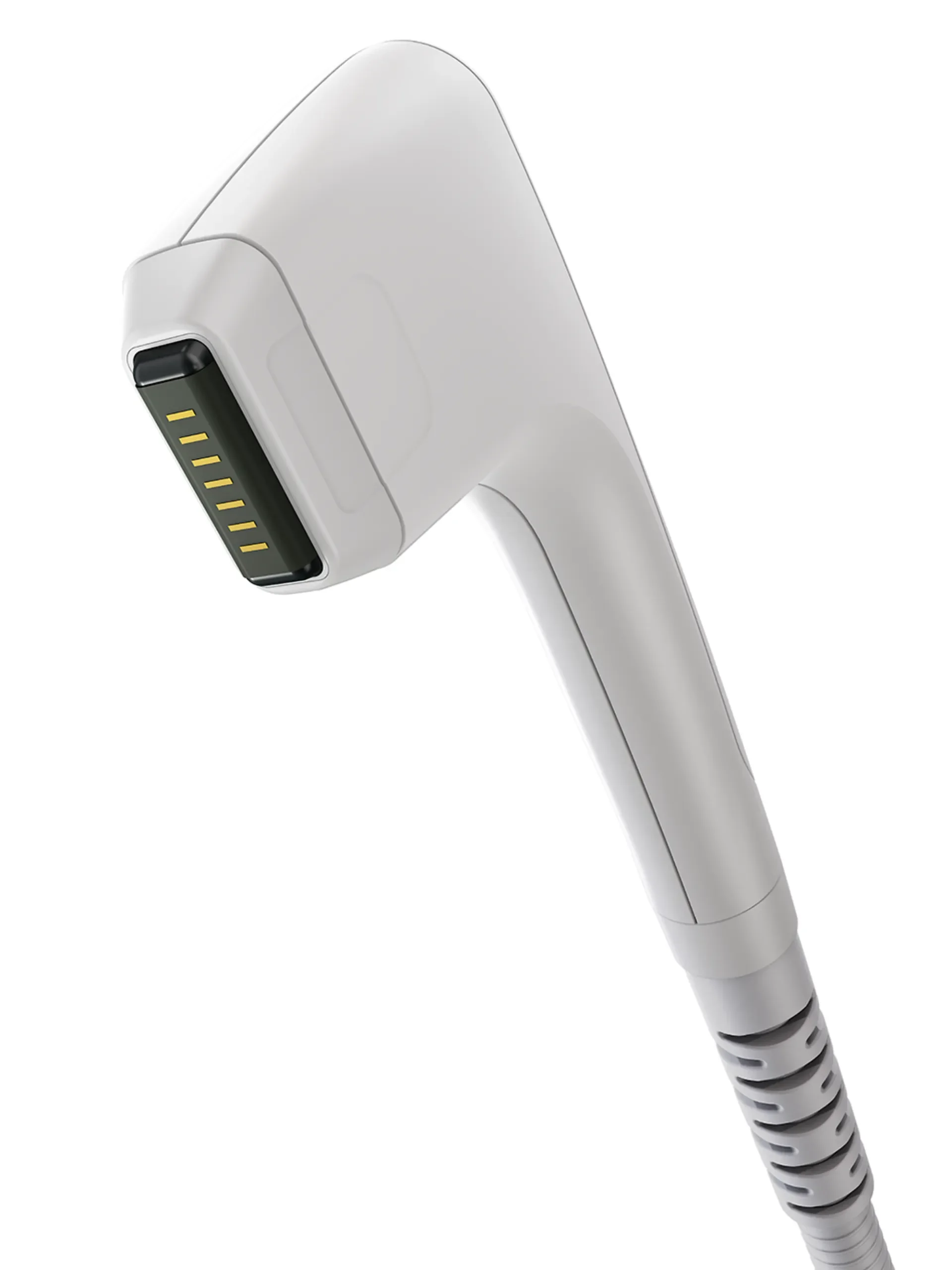
The depth question is structurally different between Sofwave and the RF microneedling category, and the structural difference is the cleanest way to understand why the two modalities produce different clinical signatures. Sofwave delivers its energy at a fixed depth of approximately 1.5 millimetres into the mid-dermis, calibrated for dermal collagen-and-elastin remodelling. The depth is a design constant — the seven-transducer SUPERB array is engineered for that single depth, and the operator does not adjust it. RF microneedling platforms in contrast deliver radiofrequency energy through arrays of micro-needles that the operator inserts to a depth the operator selects, typically anywhere from 0.5 millimetres to 4.0 millimetres depending on the platform's needle length and the clinical indication. Potenza's needle depths run from approximately 0.5 to 3.5 millimetres with insulated and non-insulated tip options that further modify the thermal distribution. Sylfirm X operates in a similar 0.3 to 4.0 millimetre depth range with its dual-wave radiofrequency selecting whether the energy pattern is pulsed for vascular-and-pigment indications or continuous for tightening indications. The clinical consequence is that Sofwave is a single-depth platform optimised for one clinical layer, while RF microneedling is a multi-depth modality whose flexibility allows the operator to address several layers in a single session by varying needle depth pass-to-pass. The Sofwave fixed-depth design produces predictable, uniform mid-dermal remodelling without operator-dependent variability. The RF microneedling variable-depth design produces operator-dependent results — a senior operator who calibrates needle depth and energy precisely produces meaningfully different outcomes than a junior operator running the platform on default settings. For comparison context, Sofwave Medical's clinical-evidence library is the authoritative reference.
Mechanism: synchronous ultrasound coagulation versus radiofrequency thermal injury
Beyond depth, the two modalities differ in the fundamental physics of energy delivery, and the physics difference explains most of the downstream differences in pain, downtime, and results trajectory. Sofwave uses synchronous ultrasound beams: the seven-transducer SUPERB array fires simultaneously, producing seven coordinated coagulation zones per pulse, with the ultrasound energy converging at the calibrated 1.5 millimetre depth and producing controlled coagulation that the body remodels into collagen over the months that follow. There is no needle penetration, no epidermal disruption beyond the transient warmth of the pulse, and no break in the skin barrier. RF microneedling uses electrical-resistance heating of tissue around inserted micro-needles: the needle array penetrates the skin to operator-set depth, radiofrequency current flows through the tissue between needles, and the resistance produces thermal injury along the needle tracks. The Sofwave coagulation zones are discrete points within otherwise undisrupted dermis, suitable for collagen-and-elastin remodelling without epidermal change. The RF microneedling thermal injury zones are linear along needle tracks with surrounding thermal-spread to operator-set radius, suitable for combined epidermal-and-dermal remodelling with the added vector of needle-induced micro-channels that some platforms exploit for topical-actives delivery. The mechanism difference is why RF microneedling is widely used for pigmentation, vascular, and texture indications that Sofwave is not engineered to address. Korean clinical practice patterns are documented in KHIDI Korea Health Industry Development Institute references.
Pain profile: tolerable warmth versus operator-dependent intensity
The patient-experience comparison is where Sofwave and RF microneedling produce some of the most noticeable signature differences. The honest read is that Sofwave is meaningfully more tolerable than typical RF microneedling protocols at clinically effective energy settings, while RF microneedling intensity varies dramatically with operator-set parameters. Sofwave patients describe brief warm-pulse sensations at each beam pulse, occasionally a fleeting sharp sensation at higher energy settings near the bony landmarks of the face. Topical anaesthetic for 20 to 30 minutes is standard pre-treatment, and oral analgesia is rarely needed. RF microneedling protocols at clinically effective settings — meaning needle depth sufficient to reach the target dermal layer and energy sufficient to produce visible coagulation along needle tracks — typically require topical anaesthetic for 45 to 60 minutes, nerve-block injection in some cases, and occasional intravenous sedation for patients with low pain tolerance or for full-face protocols. The sensory pattern is also different — Sofwave is felt as discrete warm pulses progressing across the treatment area, while RF microneedling is felt as the needle insertion followed by deeper thermal warmth that some patients describe as a deep ache rather than a sharp sting. Operator-dependence is the larger variable for RF microneedling than for Sofwave: the same RF microneedling platform run by a senior operator at calibrated parameters produces a different patient experience than the same platform run by a junior operator at default parameters. Pain tolerance is documented as a clinically significant input by the American Academy of Dermatology patient-resource library.
Downtime: functionally zero versus 24 to 72 hours of visible recovery
The downtime comparison is one of the most decision-relevant differences for international patients flying into Gangnam for a short trip. Sofwave is functionally zero-downtime within the operative-medicine definition — no incisions, no needle penetration, no bandages, and no functional restriction on daily activities. The post-treatment signature is mild erythema for two to four hours, occasional transient warmth, no swelling pattern of consequence, and no bruising risk in the typical case. Patients can apply makeup the same day and travel the next day looking essentially baseline. RF microneedling produces a meaningfully more visible recovery signature: pinpoint bleeding at needle entry points during the procedure, erythema for 24 to 72 hours depending on the platform and energy setting, occasional mild swelling that resolves within the same window, occasional bruising at higher energy settings particularly at the periorbital and perioral zones, and a visible track pattern that is cosmetically apparent for 24 to 48 hours after most protocols. For an international patient flying back to Singapore, Hong Kong, Taipei, or Tokyo the day after treatment, Sofwave is the straightforward zero-management choice. For RF microneedling, the same patient typically requires either a multi-day buffer before any photo-sensitive event or accepts that the airport-day photograph will show visible erythema. Some Korean operators offer a low-energy RF microneedling 'finishing' protocol that minimises downtime, but the energy reduction comes at a corresponding cost in clinical effectiveness.
Results onset and trajectory: collagen remodelling on a similar three-to-six month curve
The results-trajectory comparison is one of the closer points between the two modalities. Both Sofwave and RF microneedling produce their primary result through collagen-and-elastin remodelling that matures over a three-to-six month window after treatment. Sofwave's trajectory is a gradual build with no immediate post-treatment tightening to speak of: the patient leaves the clinic looking essentially baseline, sees subtle improvement around four to eight weeks, and reaches peak result at three to six months as the mid-dermal collagen remodelling matures. RF microneedling's trajectory is similar in the broad pattern with a slightly different signature in the early window: many patients see a brief skin-quality improvement in the two-to-four week window that some operators attribute to the micro-channelling and epidermal-renewal vector, followed by the gradual collagen-and-elastin build over the three-to-six month window. The peak result is typically apparent at the three-to-six month follow-up for both modalities, and a multi-session protocol — typically two to three sessions at four-to-six week intervals — is the standard pattern for RF microneedling, while Sofwave is usually deployed as a single annual session. The candidate-selection input is the patient's treatment-tempo preference and tolerance for the multi-session commitment. The FDA-cleared indications and post-market surveillance for both categories are documented in the US FDA medical-device database.
Cost and Korean-market positioning: meaningful price-band overlap with platform variance
Korean-market pricing for Sofwave and the RF microneedling category overlaps substantially, with platform-and-session-count variance that reflects pulse density, needle-array type, physician seniority, and clinic positioning. Sofwave single-session face protocols in Gangnam-area clinics typically range from KRW 1,200,000 to KRW 3,500,000, with face-and-neck protocols at the upper end and typically deployed as a single annual session. RF microneedling face protocols typically range from KRW 600,000 to KRW 1,500,000 per session in Gangnam-area pricing, deployed as a two-to-three session protocol that brings the total pricing into the KRW 1,800,000 to KRW 4,500,000 band for the full course. The per-session pricing differential is real, but the full-course pricing band overlaps substantially. Patients comparing on cost alone often misallocate by comparing single-session Sofwave against single-session RF microneedling without accounting for the multi-session RF microneedling protocol that delivers the full clinical benefit. The cost-per-clinical-benefit calculation depends on the clinical concern and the candidacy match. For a patient with a primary mid-dermal collagen concern and a strong downtime constraint, Sofwave's single-session structure often makes the cost equation favourable. For a patient with combined pigmentation, texture, and dermal-quality concerns where RF microneedling addresses several dimensions in a single device, the multi-session RF microneedling protocol often makes the cost equation favourable. Cost is rarely the deciding factor when the candidacy is clear.
“The most common pre-consultation error in the Sofwave-versus-RF-microneedling question is treating the RF microneedling category as a single platform. Potenza, Sylfirm X, and the monopolar-radiofrequency adjacencies are materially different devices with different physics and different clinical signatures. The candidate-selection question is not 'Sofwave or RF microneedling' — it is 'which RF microneedling platform, if any, against Sofwave's fixed-depth ultrasound for which clinical concern'.”
Frequently asked questions
Is Sofwave 'better' than RF microneedling overall?
Neither is universally better. They are calibrated to different clinical layers and produce different signatures. Sofwave delivers fixed-depth mid-dermal collagen remodelling without epidermal disruption and with functionally zero downtime. RF microneedling delivers operator-set-depth radiofrequency thermal injury along needle tracks with 24-to-72 hours of visible recovery and a broader indication set that includes pigmentation, vascular, and texture concerns. The right modality depends on the candidacy match, not on which one is generally 'better'.
If I have both pigmentation and laxity concerns, which one addresses both?
RF microneedling addresses combined pigmentation-and-dermal-quality concerns more directly than Sofwave does. Some RF microneedling platforms — Sylfirm X with its pulsed-wave mode is a frequently-cited example — are specifically engineered for the vascular-and-pigment-and-tightening indication set. Sofwave is engineered for the mid-dermal collagen indication and is not the right primary platform for pigmentation. Patients with combined concerns sometimes receive a combination protocol where RF microneedling addresses the pigmentation-and-texture dimension and Sofwave addresses the deeper dermal-collagen dimension.
I had RF microneedling at home and the downtime ruined my following week — would Sofwave be different?
Yes, meaningfully so. Sofwave is functionally zero-downtime — the post-treatment signature is mild erythema for two to four hours and no needle-track recovery to manage. The trade-off is real — Sofwave addresses the mid-dermal collagen indication and does not address pigmentation or texture in the way RF microneedling does — but for the dermal-collagen indication the downtime gain is the most often-cited reason patients switch from RF microneedling to Sofwave.
Are Potenza, Sylfirm X, and INDIBA all the same thing?
No. They are platforms within the broader radiofrequency category but with materially different engineering. Potenza uses insulated-and-non-insulated micro-needles for variable thermal distribution. Sylfirm X uses dual-wave radiofrequency — pulsed for vascular-and-pigment, continuous for tightening. INDIBA is a monopolar radiofrequency platform that does not use micro-needles and occupies a separate lane closer to deep-heating radiofrequency than to RF microneedling specifically. Treating them as interchangeable is a common pre-consultation error.
Can I combine Sofwave and RF microneedling in the same Korea trip?
Yes, in some candidacy cases. Korean clinics commonly run combination protocols where the two modalities address different dimensions of the patient's concern, with appropriate spacing between sessions to allow inflammation to resolve. The senior physician's candidacy assessment determines the appropriate combination and timing — do not protocol the combination yourself.
Does Korean clinical practice prefer one modality over the other?
Korean clinical practice deploys both modalities widely and selects between them based on candidacy. The dominant Gangnam-area pattern uses Sofwave for the mid-dermal collagen indication where downtime is a constraint and uses RF microneedling for combined-indication cases where pigmentation, texture, and tightening need to be addressed in a multi-session protocol. Combination protocols are common for patients with multi-dimensional concerns.
How much should I budget for a full-course RF microneedling protocol in Gangnam?
Plan for KRW 1,800,000 to KRW 4,500,000 for a two-to-three session RF microneedling face protocol at Gangnam-area pricing, with the platform and the physician seniority producing most of the variance within that band. Single-session pricing alone is misleading — RF microneedling clinical benefit typically requires the full multi-session course.
Which modality has more long-term safety data?
Both have substantial post-market surveillance, with RF microneedling having a longer cumulative deployment history through the various radiofrequency device generations and Sofwave having a more concentrated deployment history since its initial FDA clearance in 2019. Both are well-characterised in the published clinical-evidence literature. The US FDA medical-device database is the authoritative reference for cleared indications and post-market surveillance reports.